
London Travel Tips for First-Time Tourists: Things You Should Know
London is a busy city, and if you are visiting London for the first time, you can easily get lost or feel overwhelmed while planning your trip. Here you will find valuable London travel tips that you should not underestimate, covering entry requirements (ETA vs eVisa), the best airport to land at, and how to reach central London, including journey duration, frequency, and prices and lastly, I will unfold London Public Transport from how to stop a bus, how and where to pay and how to save money.
You can also find the best apps and websites to use while visiting London for the first time, as well as some public transport etiquette.
Those London travel tips are the result of over a decade spent in town, and calling London my foster home.
Coming from a tiny village where there is only a bus which comes once every hour, to a cosmopolitan city has been more than a cultural shock, so I know how you might feel.
Time to dig into the wildness and get London a little closer to you through my London travel tips guide.
Essentials London Travel Tips! Start here👇
- 🚕 Looking for a private Airport Transfer? → Get Transfer is the answer!
- 🏨 Still deciding where to stay? Booking can accommodate all budgets and needs!
- 🍽️ Feeling hungry? → Discover the best restaurants in London (local picks & hidden gems)
- 🎡 What to do in London? → Explore London activities and tours
- 📶 Need data as soon as you land? → Airalo eSIM (no roaming stress)
- 🧳 Arriving early or leaving late? → Store your bags with RadicalStorage
Disclaimer: This Travel Guide contains affiliate links. I will receive a small compensation at no additional cost to you if you buy something I’ve recommended. I appreciate your support, and I hope this post is useful.✨
My favourite activities and tours from Get Your Guide
Before Visiting London, Get Your ETA!
A trustworthy London Travel Tips Guide cannot begin without explaining the entry requirements implemented since February 2026. There has been a new entry requirement for visiting the UK: an ETA or an E-Visa.
ETA stands for Electronic Travel Authorisation, and it must be purchased for short stays and transit.
EVisa is for people who work or study in the UK.
If you are a tourist, you need an ETA.
How To Get ETA or eVisa?
Assuming you are a tourist, don’t skip it; it is definitely one of the things tourists should know before visiting London. You will need to obtain an ETA. If you are still unsure, you can visit the government official website and, by adding your nationality and the reason for your trip, you will receive a confirmation of the type of entry requirement you must purchase. Here are a few quick steps:
- Apply for ETA on the official website here
- Check your spam folder too, and look out for an email from UK Visas and Immigration (UKVI) after 3/4 days
- Do you need a live chat? Find support here
- ETA costs £16 and lasts for 2 years – unless your passport expires before.
- An ETA does not guarantee entry to the UK.
Don’t panic, and don’t waste money on a third party to do your ETA for you.
Don’t underestimate this step! Own the process!
I suggest you apply for the ETA 7 working days (Monday to Friday) before your flight, as it should take only 3 days to receive the answer. Just in case you need some buffer time, so you can check-in for your flight in peace without stress.
Ultimately, you can apply for the ETA on someone else’s behalf; that is exactly what I will do for my parents. If you need to do so, you need a photo of their passport and a photo of their face.
My personal experience with the entry requirements
I flew back to London approximately a week after the ETA/eVisa were introduced, and at the time of flight check-in, we were prompted to confirm whether we had the necessary entry requirements documents. As we were dropping off the checked luggage, the airport ground staff asked us to prove our eVisa (we live/work in the UK).
I know it might sound stressful visiting London for the first time, but I’m sure you will feel much more confident once you reach the end of this London travel tips guide.
London Travel Tips: Which is the best airport for you?
I know, trying to buy the best flight ticket to London might be challenging, after all, London has the most airports in the world.
Luton and Stansted are both located in North London, the first on the west side and the second on the east.
The City is in the financial heart of London, close to Canary Wharf.
Gatwick is located in South London, and Heathrow is in the South West.
By the way, when you choose the airline, you will be forced to land at the airline’s home airport(s).
To explain it in other words (some airlines have several hubs):
- Heathrow: Hub for British Airways, Iberia, Virgin Atlantic, Star Alliance (Air Canada, Lufthansa, Singapore Airlines, United), Aer Lingus, Loganair, Oneworld (American, Cathay Pacific, Finnair, Qantas), Emirates, Delta, SkyTeam (KLM, Air France, Saudia), Qatar Airways, Etihad and El Al.
- Gatwick: Hub for British Airways, EasyJet, Wizz Air, and charter operators.
- City: Hub for British Airways, ITA Airways, KLM, Loganair, LOT Polish Airlines, Lufthansa, Luxair, SWISS, Aurigny, and Air Dolomiti.
- Southend: Hub for EasyJet
- Stansted: Hub for Ryanair, Jet2.com, TUI and EasyJet
- Luton: Hub for EasyJet, Wizz Air, Ryanair, TUI and Jet2.com
If you have several options, that is great, but it can also be confusing! My Travel Tip is to estimate average costs and travel times, which should help you find the best airport for your trip to London.
How to get to Central London from the Airports?
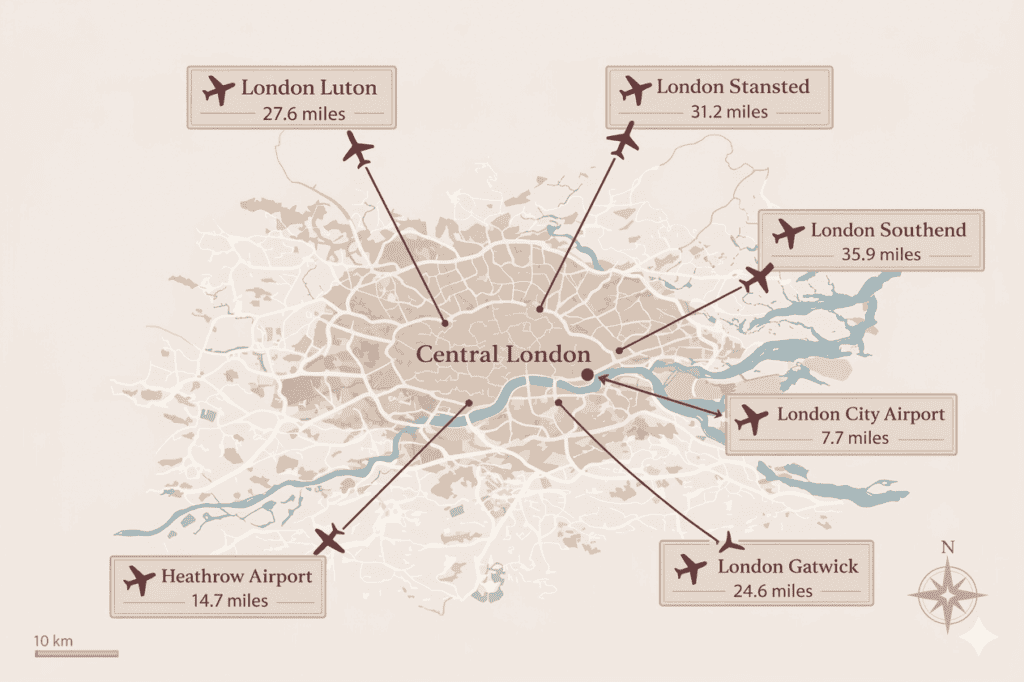
First of all, I’m super proud of myself for creating the map above (obviously, I was assisted by my AI alter ego!).
All airports are well connected to Central London. Usually, each airport offers faster/more expensive options as well as slower, cheaper options. The London Travel Tip and Trick here is to book transfers and trains in advance for the best fare.
Good to know:
- Train lines + Express Trains: Buy ticket in advance for best fares.
- Elizabeth line + tube (underground): pay contactless at the entrance (remember to tap out too)
- Check whether any strikes, Planned line closures & service changes, or engineering works are scheduled in advance, too.
- When buying tickets for the National Express/Coaches in advance, always consider purchasing at least 1 hour after your scheduled landing time to allow time to go through security, collect your luggage, and perhaps build in a buffer if the flight is delayed. Usually, they will allow you to board the following journeys if you miss your original time.
London Travel Tips Guide: How to reach Central London from Heathrow Airport?
Here you can find an easy breakdown of how to reach Central London when landing at Heathrow.
Bear in mind that the airport has 4 terminals, 2&3 are located together, 4 and 5 are separate.
My suggestions + Good to know
Choose the Elizabeth Line over the Heathrow Express because it is cost-effective and still fast (unless you get an advance ticket for £10).
Choose the Tube over the coach as it is cheaper, faster and gets you to the heart of London.
- Heathrow Express: Book at least 30 days in advance for fares from £10. Trains run every 15 minutes from morning till night. For Terminal 4, get off at Terminal 2 or 3 and take the free 4-minute transfer train.
- Elizabeth line: All terminals connect to Central London and beyond, with several trains per hour. Fares are based on your final stop. For example, a ticket from Terminal 5 to Bond Street (Zone 1) costs £15.50 and takes around 35–40 minutes.
- Tube (London Underground): The Piccadilly Line connects the terminals to central London (Piccadilly Station) in 50 minutes for £5.90.
- National Express (Coach): A budget-friendly option to get from terminals to London Victoria Station, with fares starting at £5 if booked in advance, otherwise around £7-£8. The bus operates 24 hours with varying frequencies and durations. Get 20% off by using my referral code REF9Y5WH.
|
Avg. Cost |
Time |
Frequency |
|
|---|---|---|---|
|
Heathrow Express |
£26 / £42 (round trip) |
20 minutes to Paddington Station |
every 15 minutes |
|
Elizabeth Line |
£15.50 |
35 minutes to Bond Street Station |
every 30 minutes |
|
Piccadilly Line (Underground/Tube) |
£5.90 |
50 minutes to Piccadilly Station |
every 10/15 minutes |
|
Buses/Coaches: |
£8 |
60/90 minutes to Victoria Station |
every 20/40 minutes |
Which is the best way to reach Central London from Gatwick Airport?
If you are visiting London for the first time, you should know that Gatwick has 2 terminals, North and South. The train station is located in the South, and if you need to reach the North, just get the free shuttle, which runs every few minutes. The whole transfer time takes approximately 10 minutes.
My suggestions + Good to know
Choose the Southern or Thameslink Train Lines over the Gatwick Express because they are cost-effective and take almost the same time, with more frequent departures!
Purchase your tickets in advance for the best fares.
- Gatwick Express: Reach London Victoria in 30 minutes, and it departs twice an hour. Buying a return ticket is always cheaper. Purchase online for 10% discount. Also, they offer a Web Duo, which is a discounted fare for two travelling together.
- Southern Trains: Connect the airport to London Victoria and Clapham Junction. A cheaper alternative to the Gatwick Express with plenty of trains throughout the day.
- Thameslink Trains: Stops at various central London stations, including London Bridge and St Pancras International. It is also a great alternative to Gatwick Express.
- National Express (Coach): If you are landing late at night and not in a rush to get to London, you can reach London Victoria for £5; however, the journey takes an average of 2 hours and 20 minutes.
Get 20% off by using my referral code REF9Y5WH.
|
Avg. Cost |
Time |
Frequency |
|
|---|---|---|---|
|
Gatwick Express |
£21.5 / £42.7 (round trip) |
31 minutes to Victoria Station |
every 30 minutes |
|
Southern Train Line |
£12.50/£25 (round trip) |
33 minutes to Victoria Station |
every 5/15 minutes |
|
Thameslink Train Line |
£14.40/£26.9 (round trip) |
30/45 minutes to London Bridge |
every 5/15 minutes |
|
Buses/Coaches: |
£5 |
150 minutes to Victoria Station |
every 70 minutes |
How to reach Central London from City Airport?
City Airport is most often used by business travellers, and flights mainly depart from financial cities.
- DLR: takes you directly to Bank in the heart of London in 23 minutes, and from there you can access the major underground lines. The fare is £3.3. (FYI, DLR is a driverless light metro; don’t be scared if you don’t see a driver.)
Best way to reach Central London from Southend Airport?
Not many inbound flights to this airport yet, and perhaps not very popular, and at times not even considered amongst London’s airports, as it is located on the East Coast. However, if you have this option, you can check if it will be cost-effective and time-efficient.
- Greater Anglia Trains: Links to London Liverpool Street in 1 hr. Fares vary depending on when you book; however, one way is around £14, and return is around £30. Trains usually run every 30 minutes.
How to reach Central London from Stansted Airport?
If you are visiting London on a budget, you will probably land here. I also use Stansted a lot, as I prefer the connection to Central London, compared to Luton, for example.
- Stansted Express: Connects to Liverpool Street and departs every 15 minutes. Fares vary from as little as £10 one-way for advanced low-fare bookings to £21. Return ticket is £24. The journey is approximately 50 minutes.
First train at around 4 am and last past midnight (Depending on the route direction – Timetable here) - National Express (Coach): Leaves every 20/30 minutes and connects to Liverpool Street. The journey is approximately 90 minutes. A one-way ticket costs £7, and a return ticket costs £15 on average. Departures are 24 hours.
Get 20% off by using my referral code REF9Y5WH. - Flibco (Coach): With an average journey time of 90 minutes, links to Liverpool Street, leaving every 30 minutes. Tickets start from £7 one-way and £10 return ticket if booked in advance. (Just book a return even if you don’t need it; it might be cheaper). Departures are 24 hours.
|
Avg. Cost |
Time |
Frequency |
|
|---|---|---|---|
|
Stansted Express |
£12 / £24 (round trip) |
50 minutes to Liverpool Street |
every 15 minutes |
|
National Express Coach |
£7/£15 (round trip) |
90 minutes to Liverpool Street |
every 20/30 minutes |
|
Flibco Coach |
£7/£10 (round trip) |
90 minutes to Liverpool Street |
every 30 minutes |
Best Way to reach Central London from Luton Airport?
I flew to Luton a few times; the experience was great overall. It felt newer than Stansted, but also smaller (not that it matters after all).
- Luton Express: Connects to London St Pancras International, departing every 10/25 minutes. Fares vary from as little as £6.7 and advanced return low-fare bookings to £19.6. The journey is approximately 22 minutes.
First train is just before 6 am and last at around midnight (Depending on the route direction – Timetable here) - Thameslink Trains: Stops at various central London stations, including London Bridge and St Pancras International. It is also a great alternative to Luton Express.
- National Express (Coach): Departs every 30 minutes and connects to Marble Arch (and other central locations such as Victoria Station). The journey is approximately 80 minutes. One-way tickets cost £6 on average, and return tickets cost £13. Departures are 24 hours.
Get 20% off by using my referral code REF9Y5WH.
|
Avg. Cost |
Time |
Frequency |
|
|---|---|---|---|
|
Luton Express |
£6.7/£19.6 (round trip) |
22 minutes to London St. Pancras |
every 10/25 minutes |
|
Thameslink Trains Line |
£7.7/£15.4 (round trip) |
30/40 minutes to London St. Pancras |
every 25/30 minutes |
|
National Express Coach |
£6/£13 (round trip) |
80 minutes to Marble Arch |
every 30 minutes |
Best Private Transfers to Reach Central London from Airports
You might have a long flight or just prefer the peace of mind that comes with a private transfer to reach Central London. There are plenty of companies you could book with.
I suggest you Get Transfer as they offer a great service at a competitive price and also offer 24/7 customer service in 22 languages (perfect for my parents who don’t speak English).
Alternatively, I reserve the Taxi service from Booking, maybe not always the cheapest but trustworthy.
If I want to leave it morget spontaneous, I wait to collect my luggage and, as I’m outside, I check Uber and Bolt to see which has a better fare.
I have always been disappointed with booking Uber in advance; they have always cancelled my trip at the last minute.
📶 Need data as soon as you land? → Airalo eSIM (no roaming stress)
Understand the London Public Transport System: Everything you should know before visiting London
Giving you the freedom to explore London and feel confident when taking public transport is at the core of my London travel tips guide.
The London Underground, the world’s oldest, showcases how far we’ve come from its humble beginnings to the remarkable system it is today. The London public transport system is amazingly developed, and includes several different types of means of transport:
- Tube (or Underground)
- Overground (runs over the ground, as the name suggests, but remains within the London area)
- Trains (we all know what they are and link the entire country and beyond)
- DLR (is a driveless light metro system – mainly operating in East London)
- Elizabeth Line (a commuter train that connects the city outskirts and also goes underground in Central London stations)
- London buses (famous double-decker buses). You can get everywhere by bus!
How to pay for public transport in London?
Go contactless!
In the past, everyone had an Oyster card, but nowadays the best way to pay for public transport in London is by contactless payment.
Make sure you set your phone to a default travel bank card, or you may incur extra costs.
Every penny counts when you visit an expensive city like London!
Is Expensive Travelling By Public Transport in London?
It can add up a fair share to your budget, but there are also ways to save money.
Assuming you are visiting London for the First Time, you need to know that London is divided into fare zones. You can find the London Underground Map here; you will notice white and grey areas in the background with a progressive number. That number refers to the zone the station is in.
The more zones you cross during your travel, the more expensive the fare will be. Equally, if you travel, avoiding zone 1 will also be cheaper.
But for buses, this rule doesn’t apply. You pay by tapping your card while onboarding only, and you can travel as far as you wish by bus at the same fare, regardless of how many zones you cross.
Should you need to change buses, you must tap again when onboarding. If the tap is within 60 minutes of your previous tap, the journey is free (a hopper fare). If 1 hr is already passed, then an additional journey will be charged.
Don’t miss this London tip and trick: For other means of transport, you need to tap in and out. The reason for tapping twice is that London is divided into zones, and your travel fee is calculated based on your entry and exit stations.
What happens if you Don’t tap Correctly?
On the bus, very simply, the driver will recall you if you walk off and make you pay.
If you pay the bus correctly, you will notice 2 things:
~ Green light on the reader (will be red if you didn’t pay)
~ A single tone sound coming from the reader (will be a double tone if you didn’t pay correctly)
On the tube, you will be charged the maximum fare, as the TFL (the company that runs the public transport) won’t be able to accuratly calculate your fare.
As a rule of thumb, I suggest you always wait for the gate to be closed, so if it opens, it’s because you have tapped correctly. Don’t leave the stations without tapping out! Make sure that the light is green when tapping.
Do this: Register your contactless card to request a refund!
Happens to me, as a “Londoner”, it can happen to you: Sometimes, even if I tap, the gate opens, and the light stays orange or red, so I have to tap again and wait for the green light. That is exactly when you will be charged for the maximum fare. I have my card registered on the TFL website, so I can request up to 3 fare adjustments per month.
Even if you are visiting London for just a few days, you might want to register your contactless card on the TFL website and follow the instructions here.
If you need to request a refund, you can find all the information you need here.
Don’t stress yourself if you have a long queue of people behind you. Take your time, Tap in/out your card!
Is the London Underground running 24 hours, and how to find out the live status of the lines?
No, the tube starts early in the morning, around 5 am, and runs until roughly midnight.
However, on Friday and Saturday nights, a few lines (Central, Jubilee, Northern, Piccadilly, Victoria, and Overground) operate 24 hr.
Sunday can be quite challenging, if not the worst day to use public transport – at least for me, since I have to commute to Central London – because there are fewer journeys and they run less frequently. But if you remain central, it won’t affect you as much.
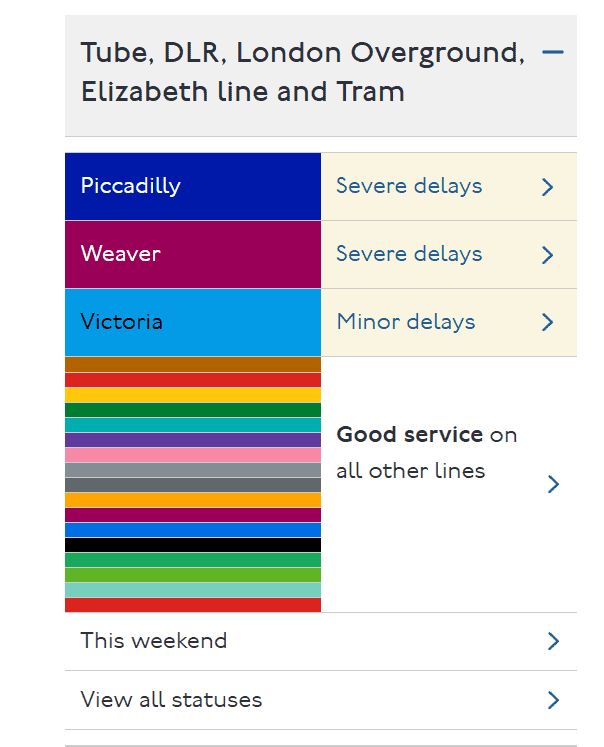
Worth checking the live status of the lines here, as there might be closures, strikes, or limited journeys.
Also, you can check in advance whether any engineering works are scheduled to disrupt your journey.
How to Save Money while Visiting London on Public Transport?
This is a true gem of my London travel tips guide. Buses have a flat fare of £1.75 per ride, but when you travel by Tube, Elizabeth Line, Overground and DLR, you have the option to travel peak and off-peak.
Basically, peak time is the AM and PM rush/commute hours and peak fares are charged between 06:30 and 09:30 and 16:00 and 19:00, Monday to Friday. If you travel outside those times, you can save money, and I believe it should be one of the things tourists should know before visiting London to better plan their itinerary and avoid feeling trapped in an overcrowded carriage.
Also, if you can avoid travelling through Zone 1, it will save you money.
Perhaps if you want to save more, consider travelling by bus, which offers a panoramic view of London and, at times, is also faster, as buses run in bus lanes closed to cars, along with taxis and motorbikes. So, traffic is not your concern most of the time.
This is how I learnt to get around the city when I first moved to London. In fact, I have to admit that only recently, since we bought a property in the countryside, I have started using the Elizabeth line and the underground; for the previous 14 years, I had only travelled around London by bus.
London Tips and Tricks: How to Stop A Bus in London
The bus won’t stop unless someone rings the bell to leave the bus or waves to the driver to stop at the bus stop to get on board.
If the next stop is yours, don’t be shy, just press the red buttons that you find everywhere on the bus.
Don’t press the last minute, as the driver needs the time to safely stop. If too, too last-minute, he might stop only at the next one. Also, ring the bell once, not every second, as long as the “bus stopping” sign is on the screen, which means the driver was made aware. (Happens that at times you press the bell but it doesn’t work; don’t panic, just press a different button!)
Hence why I also told you not to press last-minute, so if anything is wrong, you have time to press it again.
First, make sure you are at the right bus stop, as several buses run on the same street, but not all stop there. If you are not at the designated bus stop, the driver won’t stop.
You board only through the front door and only leave the bus through the middle and back doors. I always gently shout “thank you” when leaving or make a hand gesture of thanks.
Are you at the right bus stop?
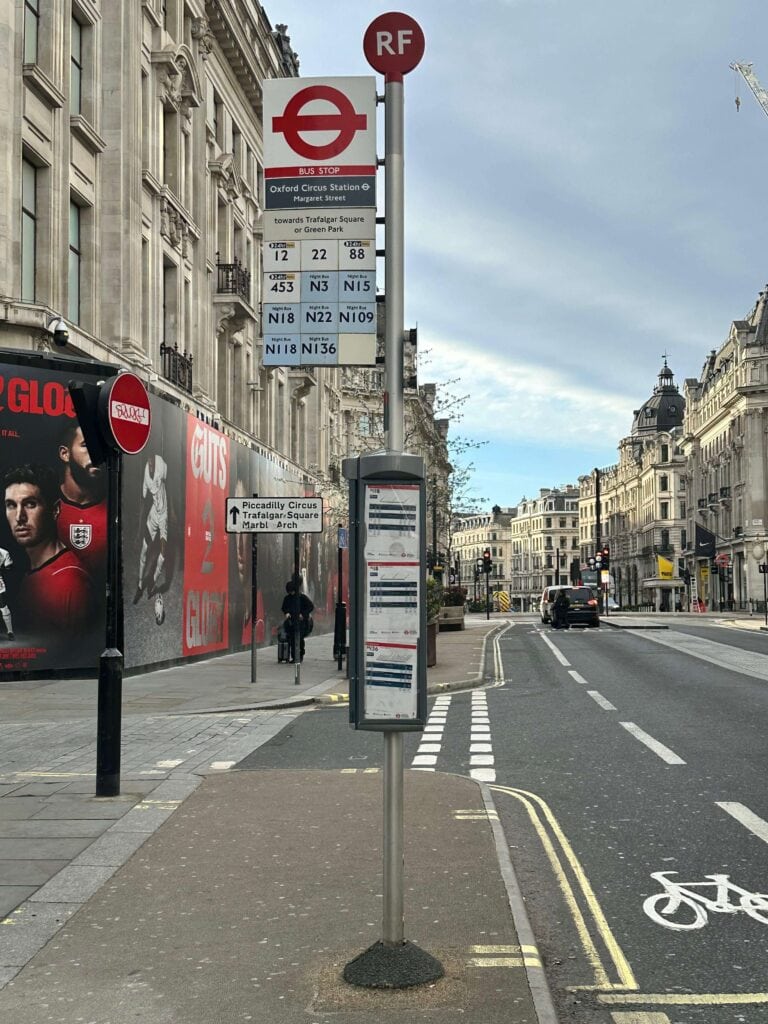
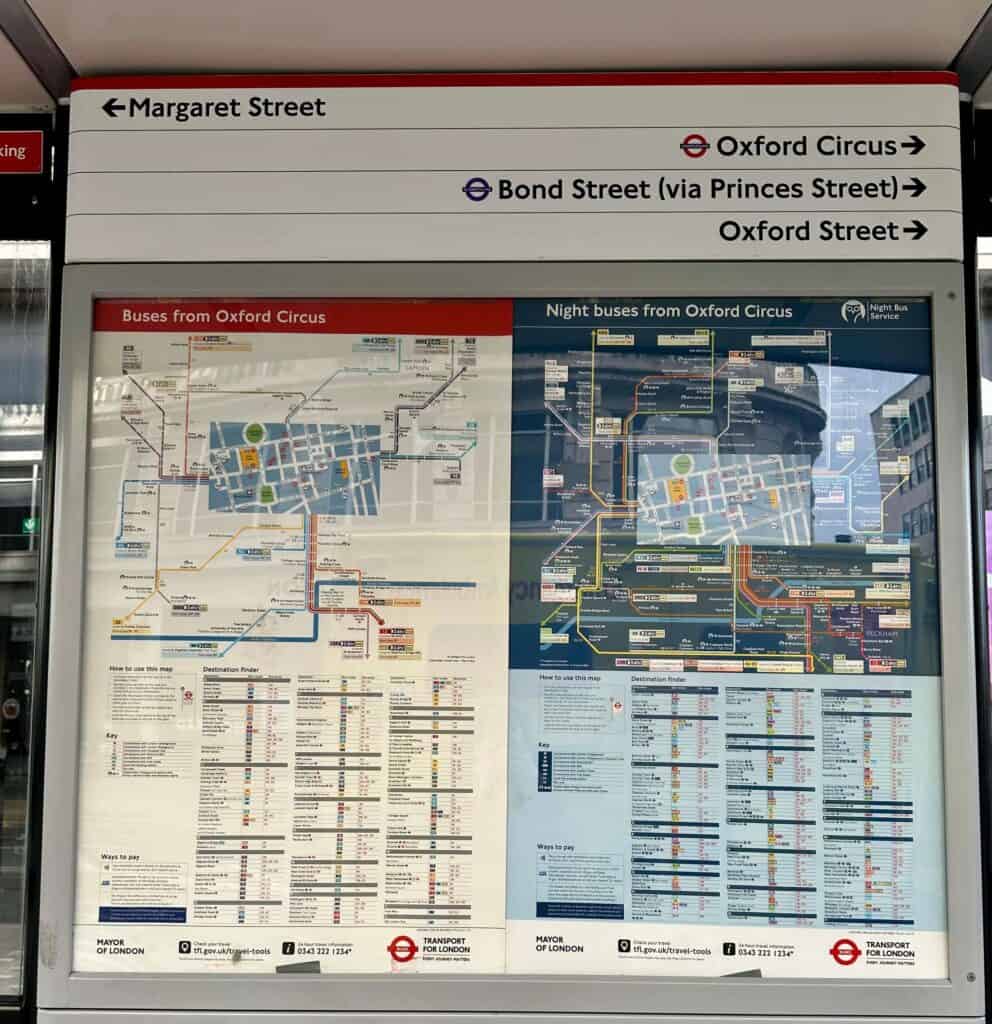
Most of the time, the same bus will run on both street directions, but obviously going to different destinations, so you need at least a little understanding of London. If you are visiting London for the first time or don’t know the city, my London travel tip is to check the bus stop map at most bus stops to see which stops you should use. London bus stops are identified by letter(s), and the panel lists the “towards (direction)” direction. During onboarding, you can always ask the driver whether he is going to your destination.
I personally like to use Google Maps for directions, and you can see the bus stop letter in the itinerary.
Understand London Bus Stops Like A Real Londoner
RF: Bus stop “number”
Oxford Circus Station/Margaret Street: Name of the bus stop
Towards Trafalgar Square or Green Park: indicate the generic directions that buses stopping at that stop will go through
12 to N136: Buses that stop there (if requested); however, there is more to know.
12, 88 & 453 24hr|Daily: those buses run 24 hours.
22: Daytime bus only (white background)
N3: Nighttime; Bus only (the N in front of the bus number + light blue background)
The bus number on a white background: daytime bus.
All operational hours and frequency are indicated in the pole.
On the other side, you have 2 maps; by now, you probably know why one has a white background and the other a light blue background. The white background shows the daytime/24hr buses, and the other one shows the nighttime/24hr buses.
Just before moving to the public transport etiquette, as part of my London travel tips, you can find below my favourite apps and websites to help you navigate the city during your trip.
Visit London for the First Time like a Pro with this Apps and Websites!
The good thing about having phones in our pockets is that they definitely help us travel and explore easily compared to decades ago.
I won’t fluff around much – App preferences are very personal.
I list here my favourite ones to inspire your trip to London.
- 🚇 Transport:
- Google Maps (Offline maps available, tells you which carriage to board, saving places, Real-time routes)
- 🚕 Taxi & Private Transfers:
- Uber (not as competitive as it used to be, but worth checking). Up to £5 off when you join using my code.
- Get Transfer (from airports to central London, great service and competitive prices!) Book your ride here!
- 🍽️ Food:
- OpenTable (great to discover where to eat based on your location, at times they might offer discounts or complementary courses/welcome drink when booked via the app)
- TheFork (discounted meal nearby)
- Too Good to Go (rescue unsold food at the end of the day from cafes, restaurants, and grocery stores at a discounted price. What you get is a suprise based on availability)
- Read my London Restaurant Reviews here and eat like a local!
- 🫗Water Refill:
- Droply
- Refill
- 🚾Public Toilets:
- Toilets4London
- Flush Toilet Finder (Worldwide app)
- 🎟️ Attractions, Tickets & Experiences
- Get Your Guide: an app that has endless opportunities to discover the city! Reserve your next activity!
- Tiqets: an alternative to GYG, with plenty of experiences and tours. Discover more.
- EatWith: Discover Food Tours led by locals. Book here!
- London Official Website: Cover everything you can imagine about London.
- 📶 Need data as soon as you land? → Airalo eSIM (no roaming stress)
London Public Transport Etiquette and Tips And Tricks
If you are visiting London for the first time, don’t stress, just have a quick read of the public transport etiquette.
To be honest, those golden rules should not be ignored and kept in mind as the most important London travel tips you can get from a Londoner.
- Etiquette:
- When waiting to get into the tube, respect the queue and stay in line and let people off the train before you try to board the carriage. Stay beyond the yellow line, which is the safe distance that you must keep.
- If you are lost, be mindful, don’t stop in front of doors/exit/staircase – stay aside and sort yourself. Ask for help if you need.
- Respect personal space! Don’t be loud, don’t play music without earphones, don’t smoke/vape, don’t eat smelly food.
- Eye contact is something you should avoid, as it is part of personal space and can create a “private bubble” while travelling, especially at peak times.
- Especially if you are taking the priority seats, you must be ready to give up your seat to older people, pregnant people, young kids, or anyone else in need.
- If you are standing, try to move down the carriage, and, even better, take your backpack or large bag off your shoulder and hold it between your feet, as it might push against someone else.
- When leaving the station, make sure you walk on one side, so people can still walk faster next to you, same applies to the escalators – stay on the right only.
- Have your card ready as you approach the barrier. If you need more time, stay on the side and re-join the queue as you are ready to pay, without passing in front of other people.
- While leaving the bus, it is always nice to “shout” a thank you to the driver.
- If you travel by bus and you are standing in the designated area for prams/disabled users, please be vigilant and give up the space if required.
- London tips and tricks:
- Carry with you a water bottle and a snack, as some tube lines can be overly hot and crowded. Keep yourself hydrated.
- Don’t stop as you get to the platform, usually the front and back carriages are quieter.
- If you are squeezed in front of the door and the next station is not yours, step out, allow people to leave, and then get in again.
- Exit strategy: now Google Maps and all the major competitors indicate which part of the carriage is best to board, based on where the exit will be in your final destination. That is clear as it can save you time.
- Remember to pay with the same card and device on the same journey (ideally, all the time) to make sure you get the best fare.
- When you see people wearing a “Please Offer Me a Seat” or “Baby on Board” badge, that means that you should give up your seat.